
If you are deciding whether to put a Barolo producer on a list, two questions usually settle it. Is the origin specific enough to defend to a customer, and is there enough behind the Barolo to keep the account busy for the other ten months of the year?
Cascina Sòt answers both. It is a family estate at Località Bussia San Pietro, in Monforte d’Alba, established in 1975. Winesal carries eight of its wines: three Barolos, a Langhe Nebbiolo, a Dolcetto d’Alba, two whites and a rosé.
Here is where they come from, how they are made, and what each one is for.
Who you are buying from

Maria and Giuseppe worked this property as sharecroppers before they owned it. Their grandson Maurizio Sanso told Winesal in October 2025 that they began in the 1950s with livestock; the vineyard was about two and a half hectares, farmed alongside hazelnuts and fruit.
They bought the estate, and their son Leonardo and his wife Silvana made winegrowing the main business. The estate dates itself from 1975.
For decades the family sold its grapes to others. That changed in 2008, when Maurizio finished his oenology studies and the family vinified a full harvest under its own name for the first time. He runs the estate today with his sister Lorena and his parents.
The sequence is worth knowing, because it cuts both ways. Estate bottling here is less than twenty years old. The vines are not: Maurizio put the parcel behind Barolo Bricco San Pietro at 96 years old when he spoke to us in 2025.
Monforte d’Alba, then Bricco San Pietro
Barolo DOCG is produced across eleven communes in the Langhe. Monforte d’Alba is one of them, and Cascina Sòt sits inside it.
Within those communes the appellation also recognises named vineyard areas: menzioni geografiche aggiuntive, MGA for short. Bricco San Pietro is one of Monforte’s. It is a regulated designation rather than a name the winery chose, which is why it carries weight when it appears on a list.
Maurizio describes Monforte’s soils as calcareous and clay marls, and credits them for the structure and ageing capacity of the reds.
The appellation rules set the floor: Barolo must be made only from Nebbiolo, and must age at least 38 months from the November after harvest, of which at least 18 months in wood. Riserva requires 62 months. Everything below goes beyond that minimum.
Three Barolos, three different jobs
All three are 100% Nebbiolo. What separates them is where the fruit comes from and how it is aged. That difference is the sales argument, so it is worth getting right.
Barolo del Comune di Monforte d’Alba
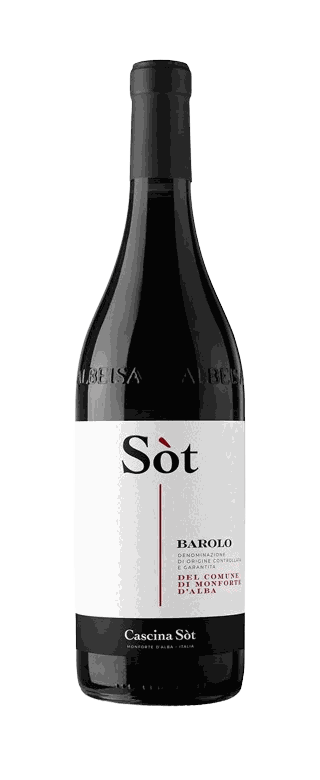
Fermented in steel for 20 days at around 28°C, with three pump-overs and three manual punch-downs a day. Then 32 months in large Slavonian oak casks and six months in bottle. 14.5% abv, served at 18–20°C.
Garnet, with ripe red fruit, spice and a floral edge; full-bodied, with firm but silky tannins. Our catalogue points it at hearty meat dishes and aged cheeses.
Large, neutral oak and commune-wide sourcing make this the clearest statement of what Monforte tastes like at this estate. It is the wine for an account that wants a real Barolo listing that moves, rather than a trophy that sits.
Barolo Bricco San Pietro
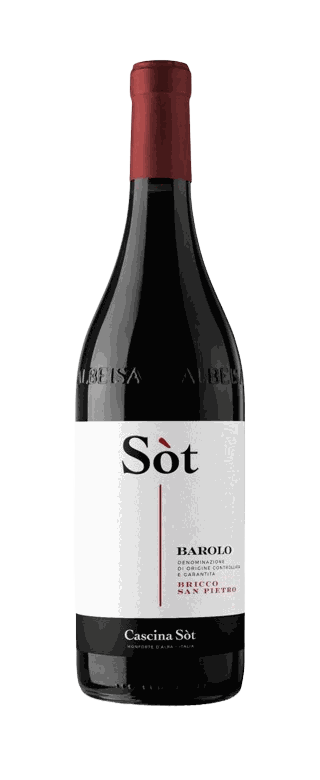
Picked in the middle or end of October and fermented in wooden vats for 25 days at 27–29°C, again with three pump-overs and three punch-downs daily. Ageing is 28 months in French oak (60% new tonneaux, 40% second-fill barriques), followed by a year in bottle. 14.5% abv, served at 18–20°C.
Ruby with garnet reflections; a broader nose than the commune wine, with ripe red fruit and darker spice (black pepper, nutmeg). Fine, integrated tannins and a long finish. Built for lamb and red meat.
A named MGA, French oak, and a year of bottle age before it leaves the cellar. This is the hand-sell: the bottle a sommelier can build a story around, and the reason to give the producer a place on the list rather than just a wine.
Barolo Bricco San Pietro Riserva
Same vineyard, longer élevage: 32 months in French oak tonneaux, then two and a half years in bottle. The estate makes it only in vintages it rates highly. 14.5% abv, served at 18–20°C.
Deeper and more resolved than the standard bottling, with the tannins fully knitted in. The catalogue places it with aged cheeses, red meat and game.
Treat it as an allocation, not a standing line. Confirm the current vintage and the quantity available before you promise it to an account.
What sells the rest of the year
Barolo opens the conversation. The rest of the range is what justifies the listing slot.
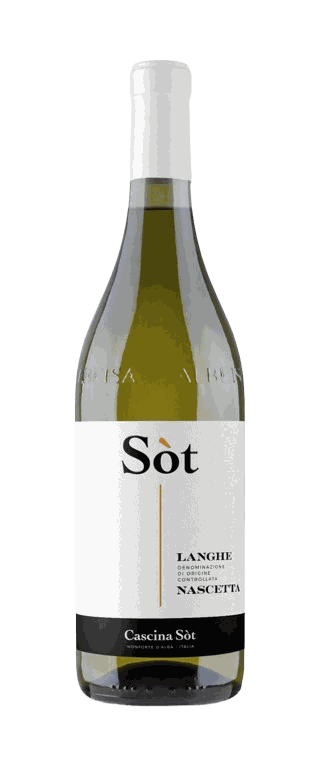
Langhe Nascetta is the one to lead with. Nascetta is a white grape native to the Langhe, and the estate gives it five to six days on the skins, then fermentation off the skins for 20 days at 13–15°C, and two months of bâtonnage. 13.0% abv, served at 10–12°C.
The skin contact shows: peach and white flowers on the nose, then a faint tannic grip and a mineral edge that comes from the time on skins. It gives a restaurant a white from the same family as the Barolo, made from a grape most lists have never carried.
The other four, as Winesal holds them:
- Piemonte DOC Chardonnay: 13.0% abv, six months in stainless steel, served at 6–8°C. White flowers and orchard fruit, no oak. The straightforward white, for accounts that need one.
- Tramonto: rosé from Nebbiolo and Barbera, 13.5% abv, served at 6–8°C. Pale, with red fruit and citrus. Aperitif, light starters and white meat.
- Dolcetto d’Alba DOC: 13.5% abv, served at 14–18°C. Violet, plum and black cherry; smooth and easy. The food wine of the range and the one that will drink through a whole menu.
- Langhe DOC Nebbiolo: 14.0% abv, served at 15–18°C. Rose, violet and red fruit over soft tannins. The bridge: same grape as the Barolo, ready now, and the fastest way to introduce the estate to a table.
One gap to raise early: the estate also produces Barbera d’Alba and Barbera d’Alba Superiore, the Superiore from a vineyard Maurizio put at around 70 years old. Neither is currently in the Winesal catalogue. If Barbera matters to your list, ask before you plan around it.
How they farm and vinify
The estate has stopped using herbicide in favour of grass cover between the rows, which keeps the soil cooler and holds it together in heavy rain. It has also cut back the more aggressive plant-protection products in favour of copper- and sulphur-based ones.
Repeat it precisely when you sell it, because that is what the estate claims and no more. Copper and sulphur are still treatments, "no herbicide" is not "no spraying", and none of it is an organic certification. Maurizio told Winesal the estate has held SQNPI certification (Italy’s integrated-production standard) since 2014.
Two cellar details are unusual enough to be worth repeating to a customer. The estate uses winter cold rather than refrigeration to achieve tartaric stability, and draws cold water from an old well on the property to control temperature during vinification.
On timing, Maurizio names hotter and less predictable seasons as the estate’s main problem, and says harvest dates are set on phenolic ripeness rather than sugar alone.
Before you list them
Four things to settle with us first:
- Current vintage and technical sheet for each Barolo. The ageing periods above are the estate’s standard practice; individual vintages can differ.
- Riserva availability, if you want it: which vintage, how many bottles, and when it is released.
- Whether the two Barberas can be added to your shipment.
- Case configuration and lead time for your market. Winesal holds stock in Nave, Brescia, and ships within 72 hours of an order.
The next step
Request the catalogue and we will send the full Cascina Sòt entry, or request samples and taste the range in sequence: Langhe Nascetta, Langhe Nebbiolo, Barolo del Comune di Monforte d’Alba, then Barolo Bricco San Pietro. Four wines is enough to show how the estate builds from a native white to a single-MGA Barolo, and to tell you whether it belongs on your list.
If you would rather talk it through first, book a call with Andrea Salvadori.