Aglianico del Vulture is a red wine from a delimited volcanic area in northern Basilicata, made from Aglianico. Buyers should separate the broader DOC from Aglianico del Vulture Superiore DOCG, then judge each producer's sites and élevage. Donato d'Angelo offers a practical Winesal case: four catalogue entries with different grapes and designations, only two of which are listed as Aglianico del Vulture DOC.[1]
Begin with Vulture, not with the northern nickname
“Barolo of the South” is memorable but commercially imprecise. Aglianico is not Nebbiolo, Monte Vulture is not the Langhe, and the comparison encourages staff to sell borrowed prestige. The defensible starting point is the protected origin.
The Consorzio di Tutela states that Aglianico del Vulture DOC was recognised in 1971 and that its production zone occupies the north-east of Basilicata. The listed municipalities include Atella, Barile, Ginestra, Melfi, Rapolla, Ripacandida, Rionero in Vulture, Maschito, Venosa, Ruvo del Monte and San Fele.[2] The exact consolidated specification, rather than a regional map alone, should be used for legal label work.
Aglianico del Vulture Superiore became a separate DOCG through a 2010 decree and production specification.[3] That does not make every Vulture wine a DOCG, nor does it make DOC a synonym for entry level. A producer can choose a denomination according to vineyard, composition, maturation and commercial intent.
For the list, lead with three pieces of information: Aglianico, volcanic northern Basilicata, and the exact designation on the bottle. Add producer and vineyard details only when a current sheet supports them.
Volcanic origin is geography, not a flavour descriptor
The word “volcanic” can become lazy tasting language. It establishes the geological context of Monte Vulture, but it does not prove that every wine tastes of smoke, ash or stone. Those descriptors belong in a tasting note only if the taster finds them in the sample.
The better buyer questions are physical:
- Which municipality and vineyard supply this cuvée?
- What is the altitude and exposure?
- What soil description does the producer document?
- When is the fruit normally picked?
- How do vessel, oxygen and maturation differ across the range?
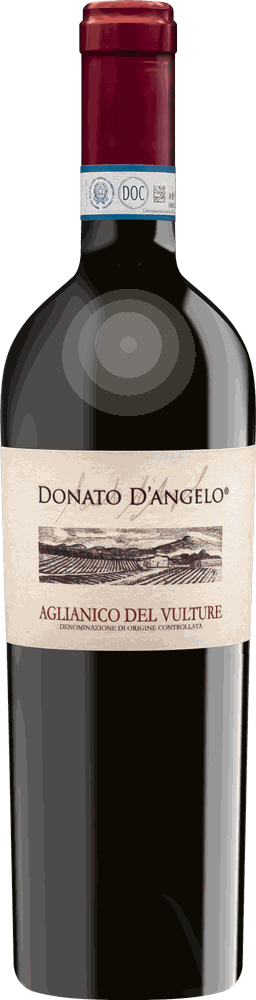
The official technical sheet for the wine named Donato D'Angelo places its vineyards in Ripacandida and Maschito at about 500 metres, on medium-textured volcanic soil. It identifies 100% Aglianico, Guyot training at 4,000 vines per hectare and harvest in the second half of October.[4] Those facts apply to that wine. They should not automatically be copied onto Calice or every wine carrying the producer's name.
This specificity is useful in a trade presentation. It replaces a sweeping terroir claim with a traceable parcel-and-process account. The customer hears where the grapes grow and how the named wine is handled.
DOC and Superiore DOCG require two different readings
The DOC is the broad working denomination. The DOCG is reserved for Superiore and carries its own stricter production rules. A buyer does not need to recite the complete law tableside, but the buying file should contain the current specifications and the bottle's compliance documents.
Use a label audit:
Field: Protected name
What to record: DOC or Superiore DOCG exactly as printed
Why it matters: Prevents staff and database miscoding
Field: Vintage
What to record: Year on offered bottle
Why it matters: Links the sample to the shipment
Field: Grapes
What to record: Producer-declared composition
Why it matters: Stops Aglianico facts leaking onto a blend
Field: Alcohol
What to record: Actual label value
Why it matters: Affects service, duty and list description
Field: Maturation
What to record: Vessel and duration for the SKU
Why it matters: Explains style without relying on rank
Field: Lot and bottler
What to record: Legal label details
Why it matters: Supports traceability
The legal hierarchy is useful, but it cannot replace tasting. A DOCG wine may suit an aged, structured list position; a DOC may fit by the glass, by the bottle or a regional pairing menu. Compare actual release dates, tannin state and account price rather than assuming the acronym decides the role.
Read Donato d'Angelo as four distinct entries
Winesal's current catalogue records Ede, Calice, Donato d'Angelo and Balconara.[1] The set should not be described as four Aglianico del Vulture wines.
Ede is catalogued as a Basilicata IGT rosé made from Syrah. It can introduce the producer in a lighter format, but it does not teach the Aglianico denomination. Balconara is catalogued as Basilicata IGT Rosso from Aglianico and Cabernet Sauvignon. It offers a regional red blend outside the DOC.
Calice and the eponymous Donato d'Angelo are the two catalogue entries identified as Aglianico del Vulture DOC.[1] The official technical sheet available for the latter gives a valuable process record: roughly ten days of alcoholic fermentation in cement, followed by at least eighteen months in wooden casks.[4] The producer's sheet also links the first vintage, 2000, to a 2003 release created when oenologist Donato D'Angelo turned fifty.[4]
Do not infer that Calice follows the same protocol. Request its own current sheet. The useful trade contrast may be site, selection, maturation, release timing or intended channel, but it must come from product evidence and tasting rather than from name order.
Design a tasting around tannin development
Aglianico's trade challenge is not simply intensity. It is deciding when the wine's acidity, tannin and fruit are integrated enough for the intended account. A structured bottle that feels promising in a quiet technical tasting may be awkward in rapid by-the-glass service.
Open Calice and Donato d'Angelo side by side. Record:
- Aromatic clarity immediately and after air.
- Tannin location and texture, not merely “high” or “low”.
- Fruit condition, from fresh to dried.
- Oak visibility and whether it supports or masks the wine.
- Finish length with and without food.
- Performance on the second day.
Add Balconara after the two DOC wines to examine what Cabernet contributes to the regional blend. Pour Ede separately, chilled as a rosé, rather than placing it in a false quality ladder. The resulting notes should make four independent purchasing decisions possible.
A braised dish, roast meat or mature cheese may reveal the reds' balance more clearly than an isolated sip, but pairings should remain account-specific. Test the food actually served by the prospective customer. Record serving temperature and decanting time so staff can reproduce the successful condition.
Sell the late season with precision
The producer sheet's second-half-of-October harvest window for Donato d'Angelo is a concrete operational detail.[4] It helps explain why Aglianico is commonly discussed as a late-ripening grape, without turning climatic generalisation into a promise about every vintage.
For a buyer, late harvest timing raises sensible questions. Ask how the estate manages selection, whether analytical data for the offered vintage are available, and what the current release has experienced in cellar. Do not imply that a later date automatically creates quality. Ripeness, acidity and tannin must be assessed together.
The same discipline applies to volcanic soils. The facts are location and producer documentation. The interpretation is the sample in the glass. A list note can say “Aglianico from volcanic Vulture vineyards” when the designation and sheet support it. It should not say “volcanic minerality” as if geology had been chemically translated into a flavour.
Build a Vulture position without category confusion
An importer can use the Donato d'Angelo set in three layers:
- Aglianico del Vulture DOC as the protected-origin core.
- Basilicata IGT red as a blending and style contrast.
- Basilicata IGT rosé as a different colour, grape and occasion.
This architecture gives each bottle a job. It also prevents the producer story from becoming larger than the evidence. Catalogue presence does not prove present vintage, stock, allocation, market rights, exclusivity or lead time.[1] Confirm those points in the offer.
For restaurant education, create a short pronunciation and location note, then devote training time to service. Staff should know which red is available by the glass, whether it benefits from decanting, and which dish has been tested. A map of Basilicata is useful. A page of heroic adjectives is not.
For specialist retail, use the DOC and DOCG distinction to encourage label literacy. If no Superiore DOCG is in the selected range, say so. The absence does not weaken the DOC wines; it keeps the presentation accurate.
The order file should be as serious as the wine
Before committing, request current technical sheets, legal labels and bottle images for each SKU. Match the tasted vintage to the quoted vintage. Confirm case pack, bottle weight, pallet configuration, certification documents, available quantity, market status and the responsible bottler. None of those details can be recovered from a regional story after the shipment is agreed.
For the eponymous wine, retain the official sheet in the account file and note exactly which statements came from it.[4] For Calice, obtain an equivalent sheet before writing detailed production copy. For Balconara and Ede, keep their IGT identities visible in databases and sales materials.
The final list language can then remain short: named producer, Aglianico del Vulture DOC, specified Vulture origin and a tasting description drawn from the approved sample. That is enough to make the wine distinctive while leaving unsupported mythology behind.
Request Winesal's current Donato d'Angelo pack and book a four-wine sample session focused on designation, maturation and account-ready service.
Sources
- Winesal, current trade catalogue entries for Donato d'Angelo, https://winesal.com/catalog. Checked 2026-07-27.
- Consorzio di Tutela Aglianico del Vulture, official denomination and production-area overview, https://consorzioaglianico.it/. Checked 2026-07-27.
- Gazzetta Ufficiale della Repubblica Italiana, recognition and production specification for Aglianico del Vulture Superiore DOCG, https://www.gazzettaufficiale.it/atto/serie_generale/caricaDettaglioAtto/originario?atto.codiceRedazionale=10A09889&atto.dataPubblicazioneGazzetta=2010-08-13&elenco30giorni=false. Checked 2026-07-27.
- Donato D'Angelo, official multilingual technical sheet for “Donato D'Angelo” Aglianico del Vulture DOC, https://www.donatodangelo.it/img/schede/aglianico.pdf. Checked 2026-07-27.