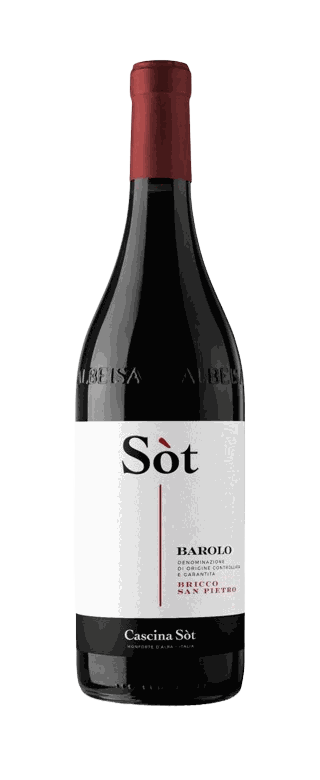
Bricco San Pietro is an additional geographical mention, or MGA, within Barolo and is associated with Monforte d'Alba. For buyers, the name gives a more precise origin than Barolo alone. It does not constitute an official quality ranking. Cascina Sòt makes the distinction practical through a sequence of Barolo del Comune di Monforte d'Alba, Barolo Bricco San Pietro and a Bricco San Pietro Riserva in its range.[3][4]
MGA is an address, not a score
Barolo labels can carry regulated geographical indications in addition to the denomination. The official Barolo framework and production specification govern how those names may be used.[1][2] In trade language, MGA is commonly used for these additional geographical mentions.
The essential buyer rule is simple: an MGA identifies origin within the denomination. It does not guarantee that every producer, vintage or bottle from that place has the same quality or style. Nor does the system create a Burgundy-like official hierarchy of grand and premier crus.
That makes producer comparison central. A geographical name becomes commercially meaningful when the wine shows a repeatable distinction, the estate can document its parcels and the account can communicate the difference without pretending the map is a ranking.
For staff training, use this sequence:
- Barolo identifies the protected denomination.
- Monforte d'Alba identifies one of its communes.
- “del Comune di Monforte d'Alba” narrows the wine to that municipal reference under the applicable rules.
- Bricco San Pietro narrows origin again to the named geographical mention.
- Riserva adds a regulated ageing category, not a different vineyard.
Five lines are enough to prevent most label confusion.
Why Monforte matters to the conversation
Monforte d'Alba is one of the communes represented within Barolo's official territory.[1][2] Buyers and sommeliers often bring stylistic expectations to commune names, but those expectations should guide questions rather than replace tasting.
Ask the producer about exposure, elevation, soil, vine age, harvest timing and cellar regimen for the current wine. Then ask which facts are stable and which change by vintage. This batch omits exact Bricco San Pietro altitude, soil and oldest-vine figures because the planning brief did not provide sufficiently authoritative current support.
The restrained version is still valuable. “Barolo from a named site in Monforte d'Alba” is specific, accurate and teachable. It lets the buyer compare origin without presenting a speculative geological lecture as fact.
Monforte also gives an account a useful tasting axis. A sommelier can place the wine beside another commune and explore differences in the glass. A retailer can present a commune-focused event. A distributor can use the municipal Barolo as the entry and the MGA as the focused step.
Cascina Sòt turns the map into a range
Cascina Sòt's official wine page presents Barolo del Comune di Monforte d'Alba, Barolo Bricco San Pietro and Barolo Bricco San Pietro Riserva, as well as Langhe Nebbiolo and other estate wines.[3] The Winesal catalogue reflects that broader range.[4]
This structure gives a buyer three separate teaching routes.
Route one: grape before denomination
Begin with Langhe Nebbiolo. It introduces Nebbiolo without asking the account to begin at Barolo's price, ageing and service expectations. The aim is not to call it “baby Barolo”, which erases its own designation. It is to establish the producer's handling of the grape.
Record aromatic clarity, tannin, acidity, oak influence and how the wine changes with air. Those observations become a reference when the Barolos follow.
Route two: commune before vineyard
Next taste Barolo del Comune di Monforte d'Alba. This wine provides the commune-level step. Ask whether it presents a coherent Monforte reference and whether it is ready for the account's release calendar.
For a restaurant, decanting trials and service temperature matter. For retail, the buyer should consider whether customers understand the municipal wording. Staff can explain that it gives a narrower origin than generic Barolo without claiming it represents every site in Monforte.
Route three: Bricco San Pietro and Riserva
Place Barolo Bricco San Pietro beside the municipal wine. The commercial question is whether the site-specific bottle offers a clear difference in perfume, structure, texture, length or development. The answer must come from the sampled vintage.
Then add the Riserva. The official specification defines Barolo's ageing and Riserva conditions.[2] A Riserva listing should therefore be sold through its release, maturity and sensory distinction, not merely through a more prestigious word.
If the MGA and Riserva are too similar for the target account at present, choose one. Completing a producer ladder is not a trade objective. Making each listing intelligible is.
A six-point sample sheet for Barolo
Barolo samples deserve a form tailored to the category.
Identity: record denomination, commune or MGA, vintage, bottle size and lot details.
Release: record bottling and release information supplied by the estate. Confirm availability separately, because a sample does not promise stock.
Service: taste on opening, after a measured period of air and with the dish or cheese category relevant to the account.
Structure: record tannin quality, acidity, alcohol integration and finish. Avoid reducing the wine to a numerical score.
Origin distinction: ask whether the municipal and MGA wines differ clearly enough to teach.
Documentation: retain the technical sheet, label image, producer details and any analysis required for the market.
This form is category-specific. It recognises that a young structured red, a mature release and an entry-level Nebbiolo cannot be judged through the same immediate-drinking lens.
Put the three Barolos into different channels
The municipal Barolo can be the restaurant's accessible estate reference, subject to landed cost and readiness. Bricco San Pietro can suit a sommelier-led account or specialist retailer that uses site names. The Riserva can fit a cellar programme, fine-wine allocation or mature-release conversation.
Those are hypotheses, not fixed destinies. One vintage may invert the order of readiness. A retailer with knowledgeable customers may make the MGA its lead bottle. A restaurant may prefer the Riserva if its menu and storage support it.
Distribution planning should also recognise the training burden. A broad account base may need one Barolo plus Langhe Nebbiolo. A narrow fine-wine group may support the complete vertical structure. Do not place all three simply because all three exist.
Plan the service calendar
The three Barolo tiers may not reach their best account moment together. Build a release calendar from the producer's current guidance and the buyer's own tasting. Record when the sample was opened, how long it was decanted, the glass used and whether food changed the assessment. Repeat the test before finalising staff instructions.
A restaurant taking a young release should decide whether it will offer the wine immediately, decant it to order or hold bottles in suitable storage. A retailer should distinguish drinking guidance from a guarantee of development. A distributor should keep vintage notes attached to the exact lot rather than reusing them when a new shipment arrives. This calendar turns “age-worthy” from a vague compliment into an operational decision about release, training and stock rotation.
Questions to ask before the order
For the current offered vintage, request:
- the exact parcels contributing to each wine;
- fermentation and maceration information;
- vessel types and total ageing;
- bottling and release dates;
- production and allocation figures the estate authorises for trade use;
- bottle formats and case configuration;
- service and cellaring guidance;
- current label and compliance documentation.
The questions are deliberately factual. Claims such as “best”, “cult”, “insider” or “underpriced” are not substitutes for them.
A precise story is enough
Bricco San Pietro does not need an inflated fame narrative. Its strongest trade story is that it is a recognised, named origin within Monforte d'Alba, interpreted by an estate that offers both a municipal reference and site-specific tiers.
For the account, this creates a compact lesson in how Barolo geography appears on a label. For the buyer, it creates a testable range architecture. For staff, it creates a sentence they can repeat safely: commune Barolo first, named Bricco San Pietro next, Riserva as the longer-aged category.
The map attracts attention, but the vintage earns the listing. Taste all three together, document the differences and buy only the steps that remain clear in your channel.
Request the Winesal catalogue and a Cascina Sòt sample flight to compare Langhe Nebbiolo, Monforte Barolo and Bricco San Pietro.
Sources
- Consorzio di Tutela Barolo Barbaresco Alba Langhe e Dogliani, official denomination resource, https://www.langhevini.it/ (Checked 2026-07-27).
- Italian Ministry of Agriculture, Barolo DOCG production specification resource, https://www.masaf.gov.it/flex/cm/pages/ServeBLOB.php/L/IT/IDPagina/18110 (Checked 2026-07-27).
- Cascina Sòt, official wine range, https://cascinasot.com/en/our-wines/ (Checked 2026-07-27).
- Winesal, current trade catalogue, https://winesal.com/catalog (Checked 2026-07-27).