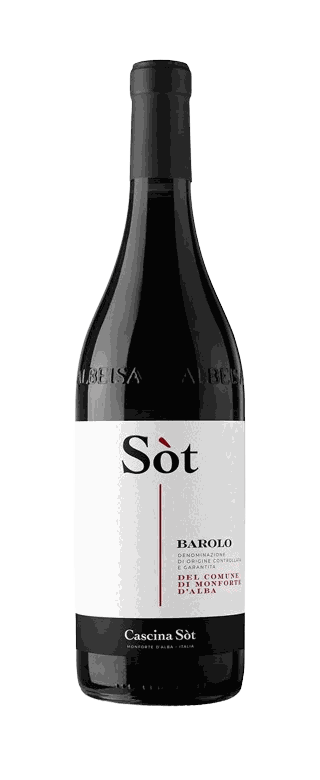
Cascina Sòt is a family winery in Monforte d’Alba whose modern story begins with Maria and Giuseppe working the property as sharecroppers, then buying it in 1975. Their grandson Maurizio Sanso now leads an estate range anchored by Barolo from Bricco San Pietro.[1] For a trade buyer, the attraction is not a manufactured dynasty. It is a traceable progression from labour, to ownership, to estate wine.
That progression gives the producer a useful commercial shape. A buyer can start with native and regional wines, move through Langhe Nebbiolo, then compare a municipal Barolo with the more specific Bricco San Pietro bottling. The family history supports that ladder without replacing the need to taste each rung.
Ownership earned through work
Cascina Sòt’s official history identifies Maria and Giuseppe as the first family generation in the account. They worked as sharecroppers before purchasing the farm in 1975. Their son Leonardo and his wife Silvana made viticulture the principal activity, while Maurizio now runs the company with support from his parents and sister Lorena.[1]
This sequence deserves precise wording. The farm buildings may be older than the family enterprise, and the date of purchase is not necessarily the first year every present label was made. What 1975 verifies is the family’s passage into ownership.
That is enough. Buyers do not need an inflated origin story when the real one is commercially strong. Sharecropping explains intimate knowledge of the property before purchase. The next generation’s focus on vines explains the move toward specialisation. Maurizio’s role connects that history to current cellar decisions and current documents.
A sales team can therefore tell the story in under a minute:
- Maria and Giuseppe worked the farm before owning it;
- the family bought the property in 1975;
- Leonardo and Silvana concentrated the business on winegrowing;
- Maurizio leads the present estate from Bussia San Pietro in Monforte d’Alba.[1]
Every point has a person, action and place. That structure is more credible than generic language about heritage.
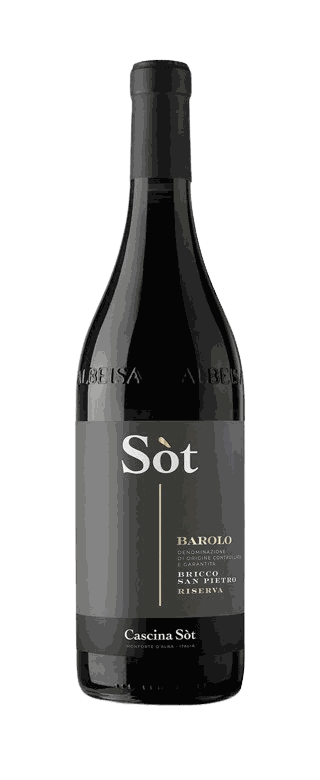
Bricco San Pietro is a regulated place name
The Barolo production specification requires Nebbiolo and defines the authorised production area, ageing categories and additional geographic mentions. Bricco San Pietro appears among those recognised mentions for Monforte d’Alba.[2] In trade conversation, the Italian abbreviation MGA is often the clearest term.
The distinction matters. “Cru” is widely understood but can sound like an official ranking. An MGA is a delimited geographic mention, not a formal quality classification. A buyer should present Bricco San Pietro as a more specific origin within Barolo, then let the wine and its method explain the rest.
Cascina Sòt’s official page identifies Barolo Bricco San Pietro as 100 percent Nebbiolo from that MGA. It lists a long maceration, maturation in French oak and further bottle ageing for the wine described on the page.[3] Current vintage sheets should confirm those details before they enter a market-specific sell sheet.
This provides a clean hierarchy:
- Barolo DOCG establishes the denomination and its rules.
- Monforte d’Alba establishes the commune.
- Bricco San Pietro establishes the MGA.
- The producer’s technical sheet establishes its choices for a particular wine and vintage.
Keeping those levels separate prevents a common sales error: treating the most specific place name as proof of superiority before the buyer has tasted.
A Barolo ladder with different jobs
The Winesal catalogue lists a municipal Barolo from Monforte d’Alba, Barolo Bricco San Pietro and a Bricco San Pietro Riserva under Cascina Sòt.[4] Availability and vintages must be confirmed from the live offer, but the architecture is valuable.
The municipal wine can introduce the estate’s Monforte language. It may fit a restaurant that wants a recognisable commune on the list or a retailer building a geographic Barolo selection. Calling it “entry-level” would undersell both the denomination and the work required to bring it to market.
The MGA wine has a different role. Bricco San Pietro can support a focused hand-sell, a Monforte comparison or a Nebbiolo seminar in which place becomes progressively more specific. The Riserva is not merely a more expensive endpoint. It needs its own vintage policy, maturation explanation, quantities and release schedule.
A buyer should ask:
- Does the municipal Barolo offer the broadest continuity?
- How does Bricco San Pietro differ in fruit source and maturation?
- In which vintages is the Riserva produced?
- Can all three wines be sampled in a coherent sequence?
- Are labels, cases and documents aligned with destination requirements?
The answers determine whether a market needs one Barolo, two or the full ladder. More listings are useful only when salespeople and accounts can explain their distinct jobs.
The range before Barolo
The current Winesal catalogue also records Chardonnay, Nascetta, Dolcetto d’Alba, Langhe Nebbiolo and other Cascina Sòt wines.[4] Those bottles are not footnotes to Barolo. They can make the estate commercially workable.
Nascetta offers a native-white conversation from the Langhe. Dolcetto can introduce the family’s red-wine style without Barolo’s release cycle. Langhe Nebbiolo can connect varietal recognition to the structure and origin of the more senior wines.
For a distributor, that creates several possible routes:
- a restaurant pour or accessible bottle that establishes the producer name;
- a native white for sommelier-led accounts;
- a regional red that supports repeat purchase;
- a municipal Barolo for the core list;
- an MGA wine for specialist placement;
- a Riserva for controlled, vintage-specific allocation.
Not every market needs every route. The point is to avoid asking Barolo alone to carry the full cost of producer development. A balanced range gives the sales team more visits, more account types and more reasons to return.
Method without theatre
Producer stories about meticulous cellar work often drift into numbers that cannot be checked. Cascina Sòt does not need that embellishment. Its official material already provides meaningful details about the family, location and Bricco San Pietro wine.[1][3]
The strongest technical presentation follows a disciplined order. Identify the exact wine and vintage. Confirm the fruit source. State maceration and maturation from the current sheet. Explain how that differs from the municipal wine or Riserva. Then taste for the commercial consequences.
That last step is essential. A maturation vessel is not a flavour guarantee. Long maceration is not automatically a quality score. The buyer needs to decide whether the wine’s structure, development and service requirements fit target accounts.
Questions for the sample meeting should include:
- How much time in bottle does the current release need after opening?
- What glassware and service temperature show it best?
- Which dishes or list positions have worked for comparable accounts?
- Does the vintage feel ready for current placement or better suited to cellaring?
- What educational material can be used without making unverified claims?
This turns method into a sales decision instead of technical theatre.
A producer story with useful restraint
Cascina Sòt’s family narrative works because it contains economic movement. Sharecroppers become owners. A mixed farm becomes more focused on wine. Estate bottling creates a family label. A geographically layered range gives buyers more than one way into Monforte.[1]
The story should not be stretched into claims that the family built an estate “from zero” on Italy’s most expensive land. Public sources reviewed here do not establish that framing. Nor should old-vine ages, laboratory-test counts or market reputation be repeated without first-party confirmation.
Restraint makes the verified facts carry more weight. A sommelier can say that the family worked the farm before acquiring it. An importer can show where Bricco San Pietro sits in the official Barolo framework. A sales representative can explain why municipal, MGA and Riserva bottlings require different placements.
That is a complete trade story.
How to evaluate Cascina Sòt
Begin with a sample sequence, not the prestige label alone. Taste Nascetta or another current white, Dolcetto, Langhe Nebbiolo, the municipal Barolo and Bricco San Pietro. Add the Riserva only if it is part of the present offer and its vintage context is clear.
During the review, record three kinds of evidence:
- sensory: structure, development, balance and service needs;
- documentary: current sheets, labels, analyses and pack formats;
- commercial: quantities, release timing, market status and intended account type.
Then write a one-sentence job for each selected wine. If two wines receive the same sentence, one may be redundant for that market. If every wine has a distinct job, the estate can support a broader launch.
Finally, ensure public copy preserves the accented name Cascina Sòt even if database records use a simplified spelling. Small details of naming signal whether the importer has handled the producer with care.
The buyer’s next decision
Cascina Sòt offers a persuasive combination: a family ownership story grounded in sharecropping, a Monforte address, and a range that can move from regional wines to Bricco San Pietro Barolo.[1][3][4] None of those elements guarantees a listing, but together they justify a serious tasting.
The right question is not whether the estate is already famous. It is whether its wines give the portfolio a clear Monforte progression, whether the commercial documents support that progression, and whether target accounts can explain the differences confidently.
Request the current Cascina Sòt catalogue, technical sheets and trade samples through /catalog.
Sources
- Cascina Sòt official site, “About Us,” https://cascinasot.com/en/about-us/ (Checked 2026-07-27).
- Regione Piemonte, “Disciplinare di produzione Barolo DOCG,” https://www.regione.piemonte.it/web/sites/default/files/media/documenti/2019-01/docg_barolo.pdf (Checked 2026-07-27).
- Cascina Sòt official site, “Barolo Bricco San Pietro DOCG,” https://cascinasot.com/en/barolo-bricco-san-pietro/ (Checked 2026-07-27).
- Winesal, “Catalogue,” https://winesal.com/catalog (Checked 2026-07-27).