Northern Tuscany offers two sharply different buying stories. Candia dei Colli Apuani DOC occupies steep, sea-facing hills around Massa and Carrara; Castagnini works about five hectares of terraces there. Farther inland, il Picchio's four Winesal-listed reds from the San Miniato hills rely on extended cement maturation.[1] Together they provide a ten-wine comparison based on unfamiliar grapes, vessel choice and small-scale landscape, not on borrowed prestige.
Two Tuscan addresses, two evidence sets
Candia has a protected DOC and an official production specification maintained by its consortium.[2] Castagnini supplies a first-party site, company history and individual wine details. That gives a buyer three layers of evidence: denomination rules, producer claims and product data.
The il Picchio record is thinner. Winesal's catalogue identifies four red wines as Colline di San Miniato IGT and provides grape, alcohol and maturation information.[1] A public producer history and current technical library were not located during research. The article therefore does not name a founder, vineyard size, certifications or founding date.
That imbalance should be visible in due diligence. It does not predetermine which wine tastes better. It determines which claims can be printed today and which documents must be requested before launch.
Use two folders in the sample room:
- Candia file: current DOC specification, Castagnini estate page, SKU sheets and certificates.
- San Miniato file: Winesal catalogue extract plus requested producer, vineyard, label and technical documents.
This is a more accurate route into northern Tuscany than combining every bottle under one generic regional paragraph.
Candia is a working landscape of terraces
Castagnini says the winery was founded in 2000 on family farming experience dating to the early 1950s. Its estate comprises about five hectares of terraced vineyards on the Candia hills, between the white-marble quarries and the sea, and reports production of around 20,000 bottles per year.[3]
The facts “quarries”, “sea” and “terraces” are visually powerful. They should not become pseudo-science. The producer says the vineyards face the sea and receive maritime breezes.[3] A buyer can repeat that geography. Claims that marble dust enters the vine or that sea air directly creates a salty taste require evidence not available here.
Terraces do imply practical questions. Ask how grapes move from steep parcels, which work is manual, how erosion is managed, and whether separate lots correspond to named wines. Request a vineyard map before attributing a specific slope to Cybo, Ceccardo or a white wine.
The official Candia production specification is the authority for permitted styles and grape compositions.[2] Product pages remain essential because a producer may choose a much narrower blend than the denomination permits.
Massaretta and Vermentino Nero make the red case
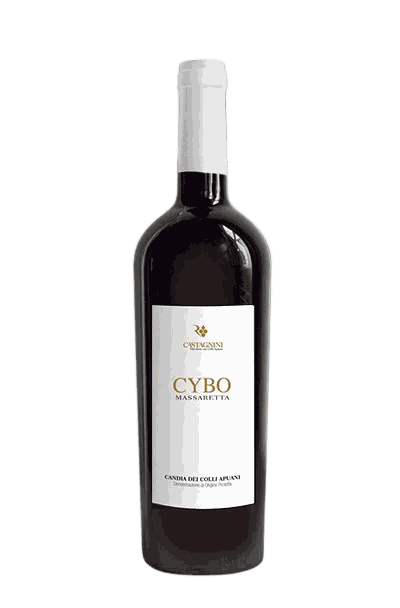
Castagnini's Cybo is made from Massaretta. The producer describes 30 days of skin maceration, one year in stainless steel and at least four months in bottle, at 13% alcohol for the page's stated release.[4] This is an unusual sequence for a red: extended maceration followed by steel rather than a wood-led maturation.
Ceccardo is 100% Vermentino Nero. Its official page states 20 days of skin maceration, no wood maturation and at least four months in bottle, with 12.5% alcohol on the published specification.[4] The difference from Cybo is not only grape. Maceration length, steel use and stated alcohol create a testable pair.
Pour them side by side and score:
Question: Does the fruit remain clear after the long maceration?
Cybo: Record sample
Ceccardo: Record sample
Question: Is tannin firm, fine, drying or soft?
Cybo: Record sample
Ceccardo: Record sample
Question: Is any wood aroma present despite steel maturation?
Cybo: Investigate if found
Ceccardo: Investigate if found
Question: Does the finish support the intended dish?
Cybo: Test account menu
Ceccardo: Test account menu
The producer's generic aromatic notes may guide preparation, but the buyer's own approved tasting note should drive sales copy. Vintage and bottle variation make direct observation essential.
Merlo supplies a third red route. Castagnini describes it as a blend of Merlot, Sangiovese, Canaiolo and Ciliegiolo, with just 12 hours of skin contact and at least two months in bottle on the published page.[4] That much shorter extraction gives the flight a process contrast that is more interesting than arranging the wines by price.
Whites and bubbles complete the Candia grammar
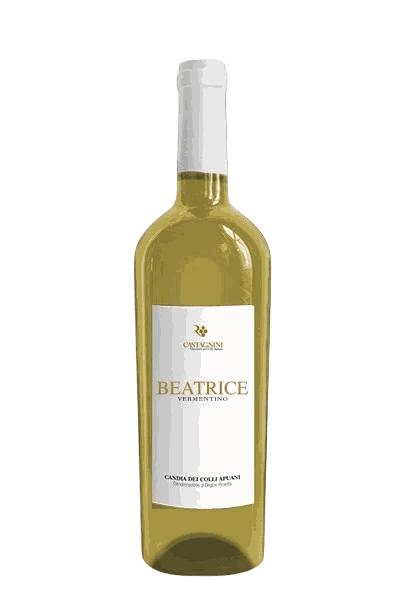
Castagnini's official range includes Beatrice and Kar Rha as Vermentino-based whites, plus La Bolla Extra Dry.[4] The sparkling wine is listed as 80% Vermentino and 20% Chardonnay, with two months of refermentation in a closed tank and 25 grams per litre residual sugar on the producer page.[4]
Those numbers allow accurate list decisions. “Extra Dry” can sound drier than Brut to an English-speaking guest, so staff should be trained on the actual sweetness category and tasted balance. The closed-tank method should not be described as traditional method.
For the two still whites, obtain the current blend and designation for each offered vintage. The public range page gives less complete detail for them than it does for Cybo and Ceccardo. Do not fill the gap by copying the DOC's maximum permissions into a product description.
A four-wine Castagnini flight can therefore show:
- Vermentino-based still white.
- La Bolla, with tank refermentation and Extra Dry dosage.
- Ceccardo, 100% Vermentino Nero.
- Cybo, Massaretta with extended maceration and steel.
The sequence teaches white and black grape identities, bubbles, extraction and maturation from one small estate.
San Miniato turns attention from grape rarity to vessel
Il Picchio's four catalogue entries are red, and cement is their shared technical reference.[1] The wines diverge in grape composition and time.
Messer Toscano combines Cabernet Sauvignon, Alicante Bouschet, Malvasia Nera and Sangiovese in the current catalogue description, with 18 months in cement. Le Pampane is listed as 100% hand-harvested Sangiovese with at least two years in cement. Cyrano combines 75% Sangiovese and 25% Syrah, followed by eight days of maceration and three years in cement.[1]
Landesco takes a different path. Winesal records Cabernet Sauvignon, Alicante Bouschet and Malvasia Nera, one year in cement, then two years in used barriques.[1] This creates a direct comparison with the cement-only wines. Used wood may contribute less overt oak flavour than new barrels, but only the sample and a current technical sheet can show its actual effect.
The vessel question is not “Is cement better?” Cement does not automatically mean neutral, traditional or natural. Ask whether tanks are lined, what their shape and capacity are, how temperature is controlled, how oxygen exposure is managed and when the wines are bottled.
Four reds can form a maturation clock
Rather than pour il Picchio from lightest to most expensive, use elapsed cellar time.
Begin with Messer Toscano at the catalogued 18 months in cement. Follow with Le Pampane at a minimum two years. Pour Cyrano after its stated three years in cement. Finish with Landesco, whose three-year path changes vessel after the first year.[1]
Keep grape composition visible throughout. Time alone does not explain the differences because the blends change:
- Messer Toscano: four-grape blend.
- Le Pampane: Sangiovese.
- Cyrano: Sangiovese and Syrah.
- Landesco: Cabernet Sauvignon, Alicante Bouschet and Malvasia Nera.
This structure turns a documentation problem into a focused technical tasting. The buyer can ask whether longer cement maturation brings integration, whether grape differences dominate, and what used barrique adds to Landesco.
All four details currently come through Winesal's catalogue.[1] Before publishing them in account materials, obtain il Picchio's approved sheets for the quoted vintages. Confirm the spelling of Alicante Bouschet, legal designations, alcohol values and bottle labels. Catalogue descriptions are a discovery layer, not a permanent specification.
A northern Tuscany range should preserve the contrast
Castagnini and il Picchio should not be blended into a “hidden Tuscany” claim that makes their differences disappear. Their pairing works because they solve different education tasks.
Castagnini offers a protected coastal-hill DOC, named local black grapes, whites and a tank-method sparkling wine. Il Picchio offers four inland reds and a structured cement-maturation comparison. One begins with denomination and landscape; the other begins with cellar vessel and documentation.
For a mixed case, select by contrast:
- One Vermentino-based Castagnini white.
- Ceccardo or Cybo, depending on which rare grape fits the account.
- Le Pampane as the cement-aged Sangiovese reference.
- Landesco to show the move from cement to used wood.
A sparkling La Bolla or a second il Picchio red can be added if the account has a distinct role. Do not add labels merely to reach a producer count.
Due diligence is part of the story
For Castagnini, request current vintage sheets, bottle images, DOC certificates, case data and the present status of any sustainability mark. The producer website records a “Biodiversity Friend” standard recognition from 2021, but a current product claim requires scope and validity documents rather than an old award-page line.
For il Picchio, request the legal producer name, address, vineyard sources, current labels, technical sheets and authorised photography. Verify every maturation period against the offered vintage. Ask whether “Colline di San Miniato IGT” is the exact label wording and how it maps to the applicable protected indication.
For both producers, record available quantity, vintage, lead time and market rights separately from editorial copy. Nothing in a public range page proves today's stock or exclusivity.
The result is a defensible northern Tuscany chapter. It shows rare local grapes without inventing extinction statistics, terraces without claiming marble flavours, and cement without turning a vessel into a virtue by itself.
Request Winesal's current Castagnini and il Picchio technical packs and book a six-wine northern Tuscany tasting organised by grape, extraction and maturation vessel.
Sources
- Winesal, current trade catalogue entries for Castagnini and il Picchio, https://winesal.com/catalog. Checked 2026-07-27.
- Consorzio Candia dei Colli Apuani, official DOC production specification, https://candiadeicolliapuani.it/il-disciplinare/. Checked 2026-07-27.
- Castagnini, official company history and estate figures, https://www.castagniniwines.it/en/our-company/. Checked 2026-07-27.
- Castagnini, official current wine range and product details, https://www.castagniniwines.it/en/wines/. Checked 2026-07-27.