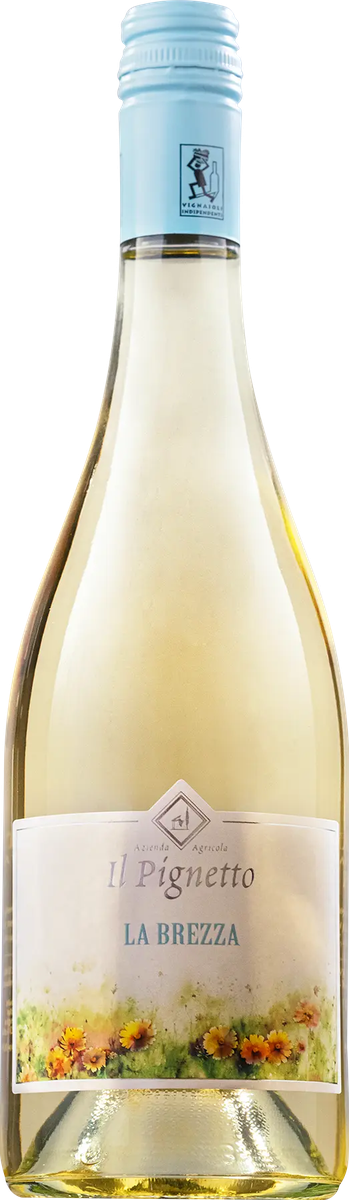
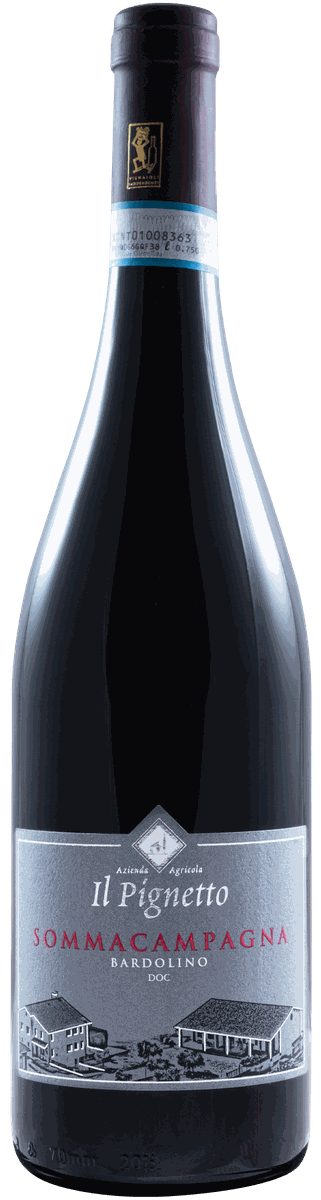
Il Pignetto is a fourth-generation family winery at Bussolengo, with Adriano Morando and his daughter Silvia working eight hectares of vines. The range includes Bardolino, Chiaretto and a Bardolino carrying the Sommacampagna subzone name.[1] For buyers, that last label is a practical way to understand Bardolino’s move toward three more specific geographic identities: Montebaldo, La Rocca and Sommacampagna.[2]
The estate’s story is not that one small winery rewrote the rulebook alone. Published interviews say Il Pignetto participated in the local discussion around the revised framework.[3] The official rules came through a collective denomination process.
A fourth-generation family in Bussolengo
The Bardolino consortium identifies Il Pignetto as a fourth-generation family estate. Adriano has completed more than forty harvests there, and Silvia, the third of his daughters, represents the next working generation. The producer is a FIVI member and says it grows, vinifies, bottles and sells its own wine.[1]
The current official site also presents the family’s work on a hill between Lake Garda and Verona.[4]
Public sources do not establish one consistent founding year, so the article avoids one. The verified chronology is relational rather than numerical:
- four family generations;
- Adriano with more than forty harvests at the property;
- Silvia now active in the winery;
- estate work from vineyard through bottle.[1]
This gives sales teams a credible account without forcing a date from contradictory profiles.
Eight hectares keep the range close to the cellar
The consortium states that Il Pignetto cultivates eight hectares of vines and about one hectare of olive trees.[1] Its vineyards lie close to the winery on the morainic hills around Bussolengo and Sommacampagna.
For buyers, the scale suggests a focused producer, but exact wine quantities still need current confirmation. Eight hectares should not be converted into assumed bottle counts or scarcity.
The proximity of vineyards and cellar can support an estate narrative:
- fruit source is geographically compact;
- the family manages the production chain;
- several local denominations meet around the property;
- a tasting can connect Bardolino, Chiaretto and Custoza.
The importer should request a parcel map showing which vineyards feed the Sommacampagna wine and which supply the broader Bardolino or white range.
What the three subzones mean
The Bardolino subzone framework recognises Montebaldo, La Rocca and Sommacampagna for wines meeting the relevant rules.[2] These are geographic indications within the Bardolino denomination, not a ranking of first, second and third place.
That point matters in trade training. A subzone narrows origin and imposes specific production conditions. It does not guarantee that every subzone wine is superior to every broader Bardolino.
A clean buyer explanation is:
- Montebaldo refers to the northern, mountain-influenced sector;
- La Rocca refers to the lakeside sector around Bardolino;
- Sommacampagna refers to the southern morainic hills;
- Il Pignetto’s specific subzone bottling is Sommacampagna.[1][2]
Before publishing detailed boundary or blend language, consult the current official specification. The 2018 proposal documents the three-name framework, but later consolidated rules should govern current labels.
Participation is different from authorship
An Italian podcast profile says Il Pignetto took part in work and discussion that accompanied the Bardolino specification changes.[3] This is a meaningful small-producer story: a family estate engaged with the future identity of its denomination.
It should not be inflated into “Il Pignetto wrote the rules”. Denomination revisions involve producers, consortium structures, regulators and formal approval.
The strongest version is:
“Il Pignetto participated in the local process around Bardolino’s renewed geographic focus and now bottles a Sommacampagna wine.”[1][3]
This statement shows involvement and outcome without claiming sole authorship. It also leads naturally to a comparative tasting.
The subzone name belongs in every trade system
Sommacampagna is not an optional flourish to drop from a shortened product name. When it appears on the approved label, the subzone should be preserved in catalogue, compliance, warehouse and account records. Otherwise the most useful geographic distinction disappears between producer and customer.
The importer should create separate product fields for:
- producer;
- proprietary wine name, if any;
- Bardolino denomination;
- Sommacampagna subzone;
- vintage;
- pack format.
This structure prevents the subzone bottling from being merged accidentally with the broader Bardolino. It also allows sales reporting to show whether accounts are responding to the more specific origin.
Staff pronunciation matters too. Record an Italian pronunciation from the producer and include it in training. A buyer who can say Sommacampagna confidently is more likely to use the geographic story at the table.
The three names should also remain separate from municipal wine terminology used elsewhere in Italy. They are denomination subzones within an approved framework, not generic village indications invented for promotion.[2]
Bardolino and Sommacampagna should be tasted together
The consortium lists both Bardolino DOC and Sommacampagna Bardolino DOC among Il Pignetto’s wines.[1] This gives a buyer a direct test of what added geographic specificity contributes within one producer.
Ask for current technical sheets and compare:
- vineyard sources;
- grape composition;
- yields and harvest;
- fermentation and maturation;
- release timing;
- analysis;
- sensory structure;
- account role.
The broader Bardolino may serve a flexible, immediate regional-red position. Sommacampagna may support a specialist list or place-led comparison. Those roles are hypotheses until the samples and commercial terms are reviewed.
Avoid calling the subzone wine a “cru” unless the producer and denomination use that term accurately. “Sommacampagna subzone” is both precise and educational.
Chiaretto gives the estate another Bardolino register
Il Pignetto’s official consortium profile includes still and sparkling Chiaretto di Bardolino.[1] These wines allow the producer to show the rosé side of the denomination.
The importer should treat still and sparkling Chiaretto as separate products with separate methods, not as colour variants of the red. Confirm:
- exact designation;
- grapes and pressing or maceration;
- sparkling method where applicable;
- residual sugar and pressure;
- release timing;
- intended service.
A launch sequence might begin with sparkling Chiaretto, move to still Chiaretto, then Bardolino and Sommacampagna. This turns one family estate into a concise denomination lesson.
Not every market needs both rosés. If the sparkling version lacks a clear account role, the still wine may communicate the estate more effectively.
Custoza completes the local triangle
Il Pignetto also produces Custoza, reflecting the overlap of wine identities in the hills between Garda and Verona.[4][5] The exact blend and label must come from the current technical sheet.
Custoza can be commercially useful as the white introduction to a producer otherwise framed through Bardolino. It may support by-the-glass placement, food pairing and broader account reach.
A four-wine estate flight could be:
- Custoza;
- Chiaretto;
- Bardolino;
- Sommacampagna Bardolino.
The order moves from white to rosé to red while geographic specificity increases at the end. It is easy for staff to remember and does not require every estate label.
FIVI has a precise meaning
The consortium profile says Il Pignetto belongs to FIVI, the Italian Federation of Independent Winegrowers, and connects membership to farming its vineyards, vinifying its grapes, bottling and selling the wine.[1]
This can be useful in specialist retail and independent-producer tastings. The logo should appear only according to current membership and brand-use rules.
Do not treat FIVI as an organic certificate, quality award or guarantee of a particular taste. It is an organisational identity based on control of the production chain.
The importer should verify current membership annually, particularly if the logo appears in printed market materials.
Buyer due diligence
Before listing Il Pignetto, request:
- current technical sheets for Bardolino and Sommacampagna;
- the consolidated current denomination rules;
- parcel map and fruit-source confirmation;
- FIVI membership evidence;
- farming statement and any certification;
- label, carton, analysis and allergen files;
- current quantities and next release;
- approved family photographs and role descriptions.
Taste Bardolino and Sommacampagna blind first, then with the geographic information. This can reveal whether the subzone story corresponds to a commercially meaningful difference for the target market.
After the tasting, write one account sentence for each wine without using “better” or “premium”. If the broader Bardolino communicates versatility while Sommacampagna communicates a narrower origin and different structure, both can earn a place. If the sentences remain identical, launch one and retain the other for future education.
Bardolino with a more precise place
Il Pignetto combines a fourth-generation family, compact estate vineyards and a clear Sommacampagna label within the renewed Bardolino geography.[1][2] Its value to buyers is not based on claiming sole authorship of the rules.
The winery can instead show how a small estate participates in a denomination’s evolution and turns the result into a bottle. Bardolino establishes the family style, Sommacampagna narrows the place, and Chiaretto or Custoza broadens the account.
Request the current Il Pignetto catalogue, subzone technical sheets and trade samples through /catalog.
Sources
- Consorzio di Tutela Chiaretto e Bardolino, “Il Pignetto,” https://consorziobardolino.it/cantine/il-pignetto/ (Checked 2026-07-27).
- Consorzio di Tutela Chiaretto e Bardolino, “Proposta Bardolino con sottozone,” https://consorziobardolino.it/wp-content/uploads/2018/08/PROPOSTA-BARDOLINO-formato-sinottico-con-allegato-Sottozone-13-04-2018.pdf (Checked 2026-07-27).
- Podcastdivino, “Azienda Agricola Il Pignetto,” https://www.podcastdivino.it/azienda-agricola-il-pignetto/ (Checked 2026-07-27).
- Il Pignetto official site, “Vignaioli sul Lago di Garda,” https://www.cantinailpignetto.com/it/cantine-lago-di-garda (Checked 2026-07-27).
- Winesal, “Catalogue,” https://winesal.com/catalog (Checked 2026-07-27).